In what way does your media product use, develop or challenge forms and conventions of real media products?
In a thriller genred film, you usually expect to see many different conventions. Including murders, suicides, dead ends, twisted storylines, crime, mystery, these conventions are used as much a possible to create atmosphere and tension. However, all of these aspects don't neccesarily need to be included in a thriller opening but an opening would ideally include some small parts of these conventions and should raise many questions for the audience. I believe that our thriller opening succesfully does this in many ways even if it isn't as gruesome as other thriller openings. Our opening's storyline is a young girl who is building up to ending her life because of an event which has previously occurred. Even though I do feel that our opening is succesful, I feel that it challenges 'normal' thriller openings in many ways.
Location:
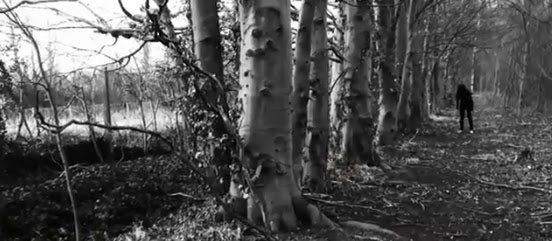
 Our thriller opening consists of two locations. One is in the main characters bathroom and the other is an unknown location which is shown throughout her story telling. Even though these locations seemed to be conventional at the time, we then struggled to find many thriller openings which we could compare this too. However, the black and white forest scenes do have a similarity to films such as 28 days later and the Crazies.
 Font and Titles:
I believe that our fonts and titles were very conventional to the thriller genre. In comparison to films such as se7ven, out fonts and titles seemed to fit in with the conventions well.
I believe that our fonts and titles were very conventional to the thriller genre. In comparison to films such as se7ven, out fonts and titles seemed to fit in with the conventions well.


Characters:
Narrative:Techniques used:
2. How does your media product represent particular social groups?
Even though the main character in our film is quite an individual, there are a few other characters in different films that we could compare her to. However, the best example to use is from the opening of Kidulthood, when the sucuidle character is building up to the moment she kills herself, alot like our opening.
3. Who would be the audience for your media product?
 From the very beginning of our planning stages, we as a group, always knew that we wanted our target audience be UK teenagers (aged 15-25 preferably). This is because we had seen the success of films in this ages group catergory such as Kidulthood and 4,3,2,1 but we saw a gap in the market, which was a thriller film fo teenagers. To the right of the page, there is a screen shot from a website called 'Comparable Profile'. This website consists of all different films that have been released with reviews and showing the audiences for that film. As a group, we looked at 4,3,2,1 and from analysing this image, it is evident that the majority of the audience for this film were 15-24 year olds. Because this is the same as our target audience age group, we can used these results and a film as an example in comparison to our production.
Certification: When deciding on the classification of thriller opening there were also many different things for me to considered. I used the research I had carried out during planning involving looking at the BBFC (British Board of Film) as a guideline. The BBFC is a non-governmental organisation, which is funded by the film industry. It is responsible for the classification and censorship of films within the UK. It has a statutory requirement to classify DVDs, videos and some video games. From looking at these different film opening, it appears that thrillers are generally certificate 15. However, more gruesome films which involve more blood are 18's. Our thriller opening does not include any blood or gore so the certificate 15 seems to be the most appropriate for us to use. Our opening involves a suicide which is less gruesome then the suicide in Kidulthood which is a 15, which is another reason why we decided not to certficate it an 18. However, because it does include a 'death' and quite intimidating music, we did not think it would have been appropriate to certificate it a 12 or a 12A.
4. What kind of media institution might distribute your
media product and why?
Before we began planning our thriller opening as a group, we all individually had to carry out institutional research which consisted of looking at all of the different media distributors and what kind of media products they distributed and why. A film distributor is an individual or a company which is responsible for the releasing films into the public. The media distrubutors I looked at were:
Universal Pictures: Based in America, they have distributed films such as 2 Fast 2 Furious, Love Actually, Bruno and Doom. Universal Pictures is the longest-lived Hollywood studio.
Paramount Pictures: Based in America, they have distributed films such as Transformers, Paranormal Activity and Twilight. It makes over £300million a year.
Paramount Pictures: Based in America, they have distributed films such as Transformers, Paranormal Activity and Twilight. It makes over £300million a year.
20th Century Fox: Based in America, they have distributed films such as Star Wars and Avatar; and has also distributed shows like The Simpsons and Family Guy
Momentum Pictures: Based in the UK, they have distributed films such as The Kings Speech, P.S I Love You and many other UK made films.
 When it came to deciding which media distributor would be appropriate for our thriller 'film', there were many different things for me to consider; but mainly I focused on what kind of films they have already distributed and what there regular target audiences tend to be. Overall, it was evident that none of my originally researched distributors were relatable to our production. However, after doing more research, it seemed that Revolver Pictures would be the best choice of distributor for our film. This is mainly because it is a UK based film distributor and overall, it's target audience always tends to be 16-25. It has made films such as Kidulthood (film cover shown to the right), Anuvahood and Sket which are all films that we looked at during our initial research and it has definitely distrubuted films that we can relate well to our target audience.
 When it came to deciding which media distributor would be appropriate for our thriller 'film', there were many different things for me to consider; but mainly I focused on what kind of films they have already distributed and what there regular target audiences tend to be. Overall, it was evident that none of my originally researched distributors were relatable to our production. However, after doing more research, it seemed that Revolver Pictures would be the best choice of distributor for our film. This is mainly because it is a UK based film distributor and overall, it's target audience always tends to be 16-25. It has made films such as Kidulthood (film cover shown to the right), Anuvahood and Sket which are all films that we looked at during our initial research and it has definitely distrubuted films that we can relate well to our target audience.
 5. How did you attract/attract your audience?
6.What have you learnt about technologies from the process of
constructing this product?
Within the process of making our final product I have learnt about and used new technologies which helped the product constuct into a final piece. The main technology I used during this whole process was an editing programme called final cut. This consisted of many things:
Editing: I used final cut to shorten and lengthen cuts which needed to be at the appropriate time (for example, if we carried on recording after the shot accidentally, we could then cut it out or even lengthen a shot so it last longer)
Re-ordering shots: After the film we realised that we didnt record in the exact order we wanted it to go in. Using final cut, i was able to re-arrange these clips so the storyline flowed. This was especially useful because we had short snappy shots jumping from one location to another.
Filter, desaturation and speed changing: All three of those things are what really gave out final product the " Atmosphere " that we wanted to create. we used the desaturation and fillers to make the neccesary shots black and white but to also darken the shots as well. The speed changing was mainly used to slow down the dripping tap but also to increase the speed on the forests scenes.
Even though it was only for a small amount, I also learnt to use photoshop. We used photoshop for our credits. It was a convient programme to use to do this because it consisted of creating the credits and pasting them onto our production in the final cut. However, we were also able to download font types and play around with them aswell. The last technology I was ment to use for our final piece was called garageband. Using garageband allowed me to experiment with track makings and eventually create a track for our opening. It was a good programme to use because it allowed us to layer up the track and downloads and add in as many sound effects as we wanted. There were other technologies I used in the construction of making our product. for the blog I worked on,I learnt how to use YouTube in a completely different way. I was able to embed YouTube links and then put them into my blogwork. This was beneficial in the whole process because i was able to write about the stages of our recording and editing and back it up with the video. it was also useful during the research stages.
7. Looking back at your preliminary task (the continuity editing task), what do you feel you have learnt in the progression from it to the full product?
Below is the preliminary task that we completed at the beginning of the course. I believe that ever since we done this, we as a group and me as an individual, have learnt many things. 1. How to use technology in more professional ways: In our preliminary we used the smallest amount of technology which consisted of a hand held recorder and final cut. Even though we were happy with our preliminary, when it came to recording out thriller opening, we wanted to have alot more professional aspects. We learnt how to use all sorts of technology (final cut, photoshop, garageband etc.) and our progression from the preliminary task improved greatly.
2. How to appreciate the resources we have and how to use them: This also helped us progress within our work because we were fully aware of what resources we had and how to use them.
3. Always have a plan of action before shooting: At the start of the thriller opening process, unlike the preliminary, we make a full plan of what we were going to do and when. This included: scripts, shooting timetables, location permissions etc. This benefited us because we were able to have a smoothly run 'set',unlike in the preliminary.
4.
5.
The main thing that was alot different when making our Thriller opening compared to our preliminary was that we were given alot more freedom and oppurtunities to be creative. For example, when doing our preliminary we were given specific guidelines of what we had to do (we had to have specific shots in a row-pan shot, close up etc); whereas, on the filming of our thriller, we had to include many different shots but we also got to choose when and where they were.