Tuesday, 27 March 2012

Eloise Evaluation


In what ways does your media product use, develop or challenge forms and conventions of real media products? 
Narrative 
flashbacks - conventional
death - conventional 
Questions - conventional

Character thriller 
Victims - eloise yasz
flawed heros - emily suicide

Techniques 
- flashbacks - black & white 
close up (eyes) show emotions etc

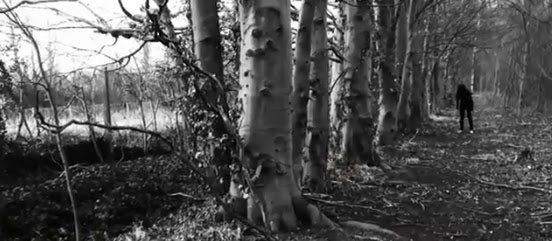
Locations - woods deserted = scary CONVENTIONAL 
Bathroom domestic - not conventional 
slow melange 

titles font conventions 
handwriting links to emily letter unconventional 

Tuesday, 20 March 2012

evaluation -Yasz Webb

In what ways does your media product use, develop or challenge forms and conventions of real media products

Conventions of a Thriller Genre

At the beginning i looked at Thriller films and analysed the use of mise-en-scene, editing, sound and camera work. this then allowed me to understand the conventions of the thriller of real media products. when we first started out we looked at toher thrillers that are out there at the moment and we were very influenced by Hitchcock's Psycho and Seven
most thrillers have the credits done over a black screen with some non-diegetic music playing black ground which sets the scene, but our opening has our credits done over the opening so you can watch while seeing the film and it has a voice over to tie it all together, also in some thrillers there is something important or vital to the film such as in The Terminator 2, our film does do that, we hve the titles "before the end" after emily has committed suicide nd after all our credits,
at the beginning of some thrillers there is a tracking or panning shot particularly the location of the film, our film has a panning shot in our second clip, it pans round to seeing emily writing her suicide letter to her parents, this is unconventional because we filmed a pan in a small room and have the protagonist in it.


In our thriller we concentrated on a subgenre which was the crime thriller, where the main plot was based around violence and death and suicide. We used this as crime can be easily related to by most people, if not, it is interesting to see what happens, We wanted to create a lot of tension and suspense in our thriller because we think that it is vital in a thriller. This was done by using a forest as one of the location, although the film wasnt all filmed in the forest, when it was, we filmed in a very small corner with very few trees.

How does you media product represent particular social groups?


we carried out research and we found that teenagers and young adults were the man target group for thrillers and were the most people who watched them, we chose to have our antagonist as a female character mainly because it challenges the stereotypical idea that antagonist are usually men mainly because men are associated with strength. we focused on both the main characters as we wanted female victim appearing vulnerable and weak, whereas the anatagonist appearing as threatening, so we kept the anatagonist identity anonymous to begin with. we used a young gilr to attract our target audience because other young people who see it can associate with the character. we try to keep it as realistic as we can through using two character of the same race, same age and of the same gender 


what kind of media institution might distribute your media product and why?


Our film is very low-budget, made by students and is unlikely to be produced by any big companies because it doesnt have quality cinematography. if we had it produced professionally it would most probably be produced by television broadcaster such as channel 4. if our product was distributed as a TV movie it could then reach the target audience because that is what they mainly watch, Channel 4 also has T4, T4 is aimed at teenagers which would suit our target auidence. this channel has already previously produced thriller films such as 'Dead set' which was hugely popular and the show wasnt a huge cost to produce our film is very similar to dead set so would be perfect to be produced by the same company. our film also has a hint of "skins" in it so maybe Channel 4's other channel E4 would be just as perfect because they have tv shows like the inbetweeners and other programmes and TV films aimed at our target audience.


 Who would be the audience for your media product?


Audience research 


to find out what sort of audience our film would target i looked at previous films that are like ours such as '4.3.2.1' i went on to http://business.pearlanddean.com/ and searched 4.3.2.1 and it came up with data of what ages went to see the film. 
from looking at this print screen there where a lot of people in our target audience age group that went to see the film (15-24) and our film is very similar to this film,


our film is going to be a 15 certificate, i think it should be a 15 becuse of language, violence and sexual scences, i think our main auidence will be mixed gender between 15 and 25 becuase it is action packed and very "jumpy"


How did you attract your target audience?


What have you learnt about technologies from the process of constructing this product?
I realised it was much easier to edit our footage if it was good quality filming from our first task, so next time I recorded several times of each shot to achieve a smooth move/correct angle. In some cases, a shot still had a fault, so we used the technology to fix that. final cut allowed us to crop shots to a shorter length so jolty movements could be removed. While having very little experience in Photoshop and never before using final cut or garage band, I had to learn all the skills needed from my peers who had used these programs before. As media has been a new subject for me, it was important to practice using a video camera, and other aspects of filming such as the language, angles and types of shots before I even considered editing. I also learnt how to correctly and efficiently upload the videos in order to start editing, 


 Looking back at your preliminary task, what do you feel you have learnt in the progression from it to the full product?

I progressed on many different levels since my preliminary task.Our group were all new to these skills so we tried shared responsibilities in different areas that we performed better than our peers in to the end product was the best quality we could achieve. I felt confident enough to manage using the camera to shoot specific scenes on my own when the other members couldn’t make it.I developed far from when I made my first task as I couldn’t even focus the camera to start with, I gained skills in camera control, full understanding of angles and lengths of shots as well as editing software When it came to filming the thriller opening, I had gained a little experience and had pre-planned what i was going to shoot before, Certain members of my group were better at tasks such as keeping the camera steady when shooting, and cutting the shot to a specific time. I realised I’m better as the creative side such as experimenting with sounds, editing colour of shots and ordering them to suit the best sequences.Learning these skills were important so I could pan smoothly, focus correctly, use affective angles and position shots while learning important rules such as the 180 degree rule you can’t break while filming. As my confidence grew in handling the camera, next I focused on effects in editing, as this area I wasn’t performing well in. I was taught colour and contrast levels, as well as how to add titles. I learnt a lot a performed these skills with care. 

Alyssa Smith's Evaluation

In what way does your media product use, develop or challenge forms and conventions of real media products?
In a thriller genred film, you usually expect to see many different conventions. Including murders, suicides, dead ends, twisted storylines, crime, mystery, these conventions are used as much a possible to create atmosphere and tension. However, all of these aspects don't neccesarily need to be included in a thriller opening but an opening would ideally include some small parts of these conventions and should raise many questions for the audience. I believe that our thriller opening succesfully does this in many ways even if it isn't as gruesome as other thriller openings. Our opening's storyline is a young girl who is building up to ending her life because of an event which has previously occurred. Even though I do feel that our opening is succesful, I feel that it challenges 'normal' thriller openings in many ways.
Location:
Our thriller opening consists of two locations. One is in the main characters bathroom and the other is an unknown location which is shown throughout her story telling. Even though these locations seemed to be conventional at the time, we then struggled to find many thriller openings which we could compare this too. However, the black and white forest scenes do have a similarity to films such as 28 days later and the Crazies.


Font and Titles:
I believe that our fonts and titles were very conventional to the thriller genre. In comparison to films such as se7ven, out fonts and titles seemed to fit in with the conventions well.


Characters:
Narrative:
Techniques used:


2. How does your media product represent particular social groups?
Even though the main character in our film is quite an individual, there are a few other characters in different films that we could compare her to. However, the best example to use is from the opening of Kidulthood, when the sucuidle character is building up to the moment she kills herself, alot like our opening. 

3. Who would be the audience for your media product?
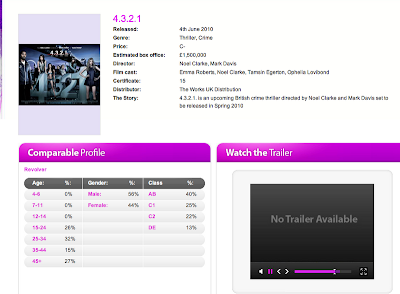
From the very beginning of our planning stages, we as a group, always knew that we wanted our target audience be UK teenagers (aged 15-25 preferably). This is because we had seen the success of films in this ages group catergory such as Kidulthood and 4,3,2,1 but we saw a gap in the market, which was a thriller film fo teenagers. To the right of the page, there is a screen shot from a website called  'Comparable Profile'. This website consists of all different films that have been released with reviews and showing the audiences for that film. As a group, we looked at 4,3,2,1 and from analysing this image, it is evident that the majority of the audience for this film were 15-24 year olds. Because this is the same as our target audience age group, we can used these results and a film as an example in comparison to our production.

Certification: When deciding on the classification of thriller opening there were also many different things for me to considered. I used the research I had carried out during planning involving looking at the BBFC (British Board of Film) as a guideline. The BBFC is a non-governmental organisation, which is funded by the film industry. It is responsible for the classification and censorship of films within the UK. It has a statutory requirement to classify DVDs, videos and some video games. From looking at these different film opening, it appears that thrillers are generally certificate 15. However, more gruesome films which involve more blood are 18's. Our thriller opening does not include any blood or gore so the certificate 15 seems to be the most appropriate for us to use. Our opening involves a suicide which is less gruesome then the suicide in Kidulthood which is a 15, which is another reason why we decided not to certficate it an 18. However, because it does include a 'death' and quite intimidating music, we did not think it would have been appropriate to certificate it a 12 or a 12A.

4. What kind of media institution might distribute your
 media product and why?
Before we began planning our thriller opening as a group, we all individually had to carry out institutional research which consisted of looking at all of the different media distributors and what kind of media products they distributed and why. A film distributor is an individual or a company which is responsible for the releasing films into the public. The media distrubutors I looked at were:
Universal Pictures: Based in America, they have distributed films such as 2 Fast 2 Furious, Love Actually, Bruno and Doom. Universal Pictures is the longest-lived Hollywood studio.
Paramount Pictures: Based in America, they have distributed films such as Transformers, Para
normal Activity and Twilight. It makes over £300million a year.
20th Century Fox: Based in America, they have distributed films such as Star Wars and Avatar; and has also distributed shows like The Simpsons and Family Guy
Momentum Pictures: Based in the UK, they have distributed films such as The Kings Speech, P.S I Love You and many other UK made films.
When it came to deciding which media distributor would be appropriate for our thriller 'film', there were many different things for me to consider; but mainly I focused on what kind of films they have already distributed and what there regular target audiences tend to be. Overall, it was evident that none of my originally researched distributors were relatable to our production. However, after doing more research, it seemed that Revolver Pictures would be the best choice of distributor for our film. This is mainly because it is a UK based film distributor and overall, it's target audience always tends to be 16-25. It has made films such as Kidulthood (film cover shown to the right), Anuvahood and Sket which are all films that we looked at during our initial research and it has definitely distrubuted films that we can relate well to our target audience.

5. How did you attract/attract your audience?
6.What have you learnt about technologies from the process of
constructing this product?
Within the process of making our final product I have learnt about and used new technologies which helped the product constuct into a final piece. The main technology I used during this whole process was an editing programme called final cut. This consisted of many things:
Editing: I used final cut to shorten and lengthen cuts which needed to be at the appropriate time (for example, if we carried on recording after the shot accidentally, we could then cut it out or even lengthen a shot so it last longer)
Re-ordering shots: After the film we realised that we didnt record in the exact order we wanted it to go in. Using final cut, i was able to re-arrange these clips so the storyline flowed. This was especially useful because we had short snappy shots jumping from one location to another.
Filter, desaturation and speed changing: All three of those things are what really gave out final product the " Atmosphere " that we wanted to create. we used the desaturation and fillers to make the neccesary shots black and white but to also darken the shots as well. The speed changing was mainly used to slow down the dripping tap but also to increase the speed on the forests scenes.
Even though it was only for a small amount, I also learnt to use photoshop. We used photoshop for our credits. It was a convient programme to use to do this because it consisted of creating the credits and pasting them onto our production in the final cut. However, we were also able to download font types and play around with them aswell. The last technology I was ment to use for our final piece was called garageband. Using garageband allowed me to experiment with track makings and eventually create a track for our opening. It was a good programme to use because it allowed us to layer up the track and downloads and add in as many sound effects as we wanted. There were other technologies I used in the construction of making our product. for the blog I worked on,I learnt how to use YouTube in a completely different way. I was able to embed YouTube links and then put them into my blogwork. This was beneficial in the whole process because i was able to write about the stages of our recording and editing and back it up with the video. it was also useful during the research stages.
7. Looking back at your preliminary task (the continuity editing task), what do you feel you have learnt in the progression from it to the full product?
Below is the preliminary task that we completed at the beginning of the course. I believe that ever since we done this, we as a group and me as an individual, have learnt many things.

1. How to use technology in more professional ways: In our preliminary we used the smallest amount of technology which consisted of a hand held recorder and final cut. Even though we were happy with our preliminary, when it came to recording out thriller opening, we wanted to have alot more professional aspects. We learnt how to use all sorts of technology (final cut, photoshop, garageband etc.) and our progression from the preliminary task improved greatly.
2. How to appreciate the resources we have and how to use them: This also helped us progress within our work because we were fully aware of what resources we had and how to use them.
3. Always have a plan of action before shooting: At the start of the thriller opening process, unlike the preliminary, we make a full plan of what we were going to do and when. This included: scripts, shooting timetables, location permissions etc. This benefited us because we were able to have a smoothly run 'set',unlike in the preliminary.
4.
5.

The main thing that was alot different when making our Thriller opening compared to our preliminary was that we were given alot more freedom and oppurtunities to be creative. For example, when doing our preliminary we were given specific guidelines of what we had to do (we had to have specific shots in a row-pan shot, close up etc); whereas, on the filming of our thriller, we had to include many different shots but we also got to choose when and where they were.

Sunday, 11 March 2012

Institutional Research

What is a film distributor?
A film distributor is an individual or a company which is responsible for the releasing films into the public. This is either theatrically (showing in the cinema) or for home viewing (DVD, Bluray, Video-On-Demand, TV programmes or for download). A distributor may do this indirectly (through sub-distributors or theatrical exhibitors) or directly (through owning the theatre or distribution network).

Paramount Pictures:
Founded in 1912, Paramount Pictures is an American film and television production/distribution company; it is located  Hollywood and it is the second oldest existing American film studio (behind Universal Studios).Paramount is ranked as one of the largest movie studios (top grossing). Paramount pictures has distibuted huge films such as: The Italian Job, Mean Girls, Transformers, Paranormal Activity and Twilight. It makes over £300million a year.

Universal Pictures:
Founded in 1912, Universal Pictures is the oldest American movie studio that is still in production today (Paramount is the second oldest). The production studios are located at Plaza Drive in Universal City, California. It has distributed films such as; Billy Elliot, 2 Fast 2 Furious, Love Actually, Bruno and Doom. Universal Pictures is the longest-lived Hollywood studio.

20th Century Fox:
Founded in 1915, The Fox Film Corporation was started by entreprenuer, William Fox. He created this by the merging of a distribution company and a production company. For many years, 20th Century-Fox was claimed to have been founded in 1915 but recently it emerged that it was founded in 1935. It has distrubuted films such as: Star Wars and Avatar; and has also distributed shows like The Simpsons and Family Guy.


Momentum Pictures:
Momentum Pictures-White&Blue 2007 cropped.jpgFounded in 2000, Momentum Pictures is one of the leading independant motion picture distributors in the UK and releases around 20 films a year. The company is owned by Paramount and is based in London. It has distributed films such as: The King's Speech, P.S I Love You, Amelie and Lost in Translation.

Which would be the best to distribute our film?
Overall, all of the researched distributors release all genred films from U's to 18's. However, I think that the most appropriate distrubutor that would apply for us would be momentum. This is because it is not as big as the others and is mainly based in the UK.

Thriller Opening Feedback

Once we had completed our 'rough cut' for our opening, we then all down together (the class as a whole) and watched the rough cuts individually to get feedback on what was working and what wasn't. As a group we decided on three questions that we wanted to ask the whole group as critical feedback. Our three questions were based on issues that we had already discovered about our thriller opening:
1. It is evident that our opening is quite confusing; do you think that this is a good thing or is it too hard to understand?
2. We've been having difficulties figuring out where the credits should go. Whats your opinion?
3. Do you think the different shots work changing from black and white to colour?

ROUGH CUT THRILLER OPENING:


Feedback:
1. 'It doesn't seem to be that confusing. It's obvious that the character is going to do something bad (commit suicide) and is having flashbacks of something that has happened. But we don't know what she is narrating on which makes us want to watch it even more.'-Nick
'I think it's good that it's not very understandable because thats what the openings are for'- Kim

2. 'It would look good if you added the credits as part of the background because you don't want to take the attention away from the intreguing storyline. Maybe a more floaty font will look good aswell'-Jake

3. 'The black and white does look good because it emphasis' that it's a dream; but you should either add black and white to all of the flashbacks bits or make it look more gloomy by adding shadows and stuff'-Joe

Teachers Feedback: You need to add in the music, credits and sounds effects. Make the editing alot sharper and snappier and try to shorten some of the clips so it doesn't drag along too much. Having more consistant effects will make the mise en scene alot more interesting and watchable.

Feedback Response:
We found this feeback very useful and constructive so after this seesion, we made a 'to do' list:
- Finish making flashback scenes black and white and then go back and darken the scenes alot more. This is to add more emphasis on the dark flashbacks the suicidal character is having.
-Add in the credits into the background of the bathroom scenes after trying out different types of fonts and colours on the scenes.
-Make and add in the music (from garageband) and compliment this with sound effects.
-Try and cut down each section as much as possible, trying to overall remove 30 seconds of film.
-Add in more voiceovers so it doesn't cut out and a random point.

Friday, 9 March 2012

Thriller Opening Rough Cut

Even though we are still in the process of editing we converted and submitted our 'rough cut' through youtube to be watched in a feedback session with the whole of the class.

Thursday, 8 March 2012

Editing Ideas and Process

Editing Ideas:
When it came to editing, we found it difficult to come up with a plan of how and what we wanted to do to our clips. After researching different editing techniques, we found this video on youtube. It is an editing sequence made by an AS media student who used final cut as the editing programme. We thought that this was relevant to us because we are also using final cut and we have a woods scene in our opening sequence aswell:

There are many things in this video that we want to be in ours. Firstly, from 0:29-0:35, the 'Alice In Wonderland' character is walking towards the camera. The lighting has been darkened quite alot and the figure has been made to look jittery and almost ghostly like.

Editing Process:
When we first started to edit our clips, we have over 40 clips to go through. After choosing all the right ones we needed to make our sequence, we then began to put them in order and cut them down to the right timings.